
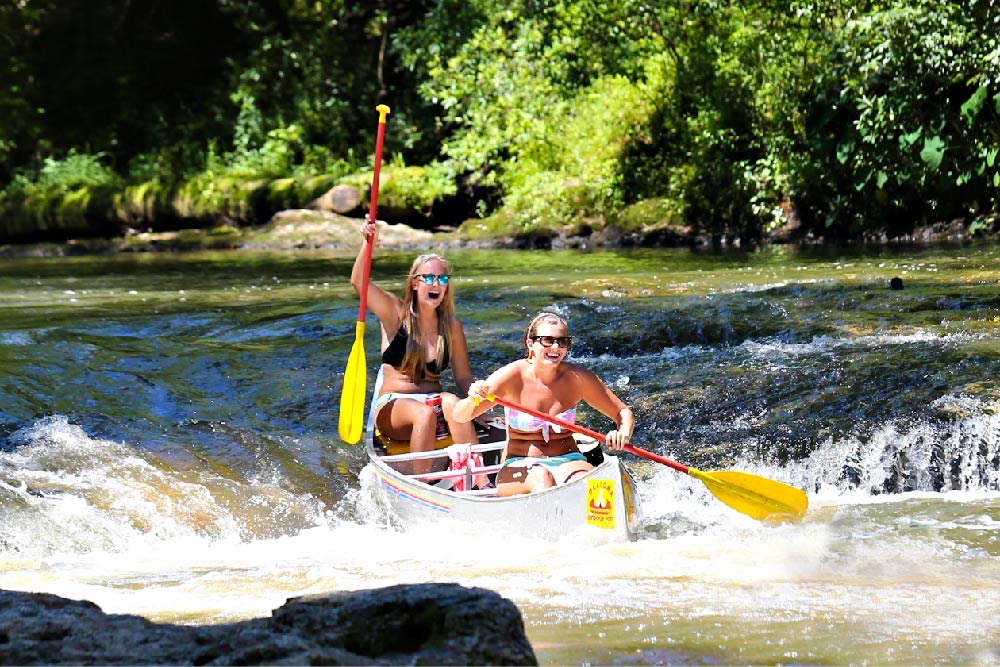
Both trips put in at Seminary · MS HWY 590
Two float trips on the Okatoma.
Seven creek miles to Fairchild's Landing, or thirteen down to Sanford. Same put-in, three falls either way, a different kind of day.
The two runs, side by side
How a float works here
You drive to the Post and you leave your car there.
We offer complimentary transportation up river for a leisurely float back to your vehicle. That is the whole shape of the day, and it is worth understanding before you book, because it decides how your afternoon ends. Your boat and your people go up the creek on our trailers. You put in at Seminary, MS HWY 590. Then you paddle back down toward where you started, at whatever speed the creek and your cooler agree on. Nobody is standing at a take-out waiting on a ride home.
The Okatoma is a Class A River, and the way it reads from a boat is this: long quiet green stretches where the current does most of the work, broken up by shoals — shallow ledges of sandstone the whole creek pours over at once. The shoals are where the noise is. Between them are sandbars and gravel bars on the inside of the bends, which is where everybody stops to eat.
In their own words, the creek is a "gently flowing pristine stream with sandbars, waterfalls, shoals, bluffs, and high banks covered with Maple, Birch, and Magnolias; creating canopy effect; variety of flora, wild life, and riverine species." That canopy matters more than it sounds. On a July afternoon in south Mississippi the difference between a creek with trees over it and a creek without is the difference between a good day and a long one.
Both trips allow ample time for picnicing and swimming. Neither one is a race. The hour figures below are what a normal group takes, not a target to beat.
Before you drive out: have a look at what the creek level means and at what to bring and what to leave in the truck. Bringing a church, a school or a scout group? That has its own page.
The most popular float
Upper Short to Fairchild — 7 creek miles
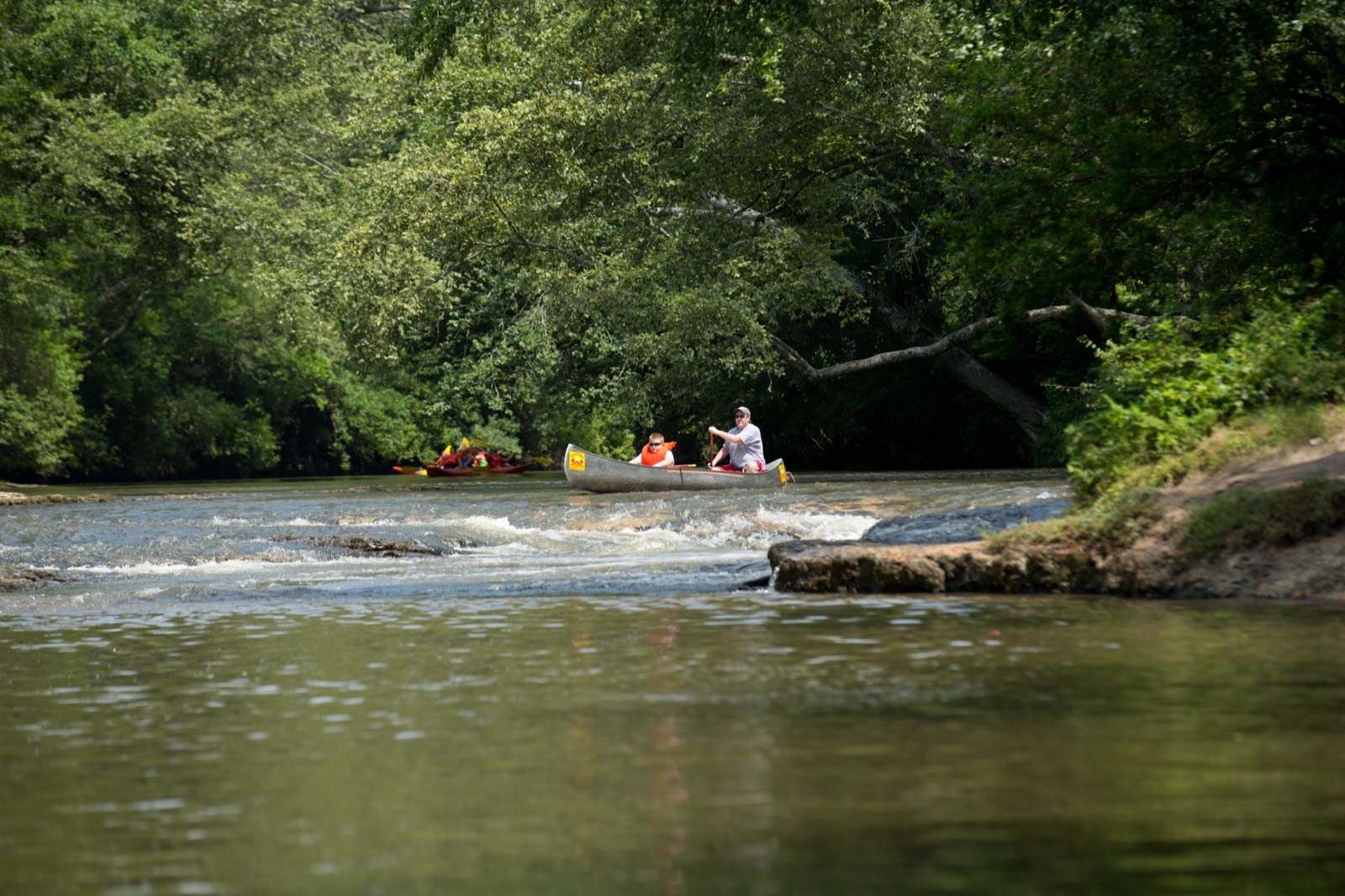
Upper Short to Fairchild of the Okatoma begins at Seminary (MS HWY 590) and ends at Fairchild's Landing. It is approximately 7 creek miles with the 3 main falls of the upper run. The trip usually takes 3 to 4 hours; this allows ample time for picnicing and swimming, which makes this the most popular float.
That is their description of it, word for word, and the numbers are the ones that matter. Here is what those numbers feel like from a seat.
Seven miles is a half day. Put in mid-morning and you are off the water in time for a late lunch; put in after lunch and you are off before supper. It is short enough that a family with young children can do it without anybody melting down, and short enough that you can stop at every gravel bar you like the look of and still not be rushed. Most of the paddling is easy — the current carries you and the paddle is mostly for steering.
The three falls are the reason this is the one everybody books. They are ledge drops, not cliffs. You hear one before you see it, the creek narrows and picks up, and then the boat goes down a step and slaps into the pool underneath. In a canoe you take them straight, square to the drop, with the bow paddler watching for the tongue of smooth water where the flow is deepest. Hit one sideways and you will find out what a wet seat feels like.
Below each fall is a pool, and below most pools is a bar to pull out on. That is where the swimming happens.
The long one
The Upper Run — 13 creek miles
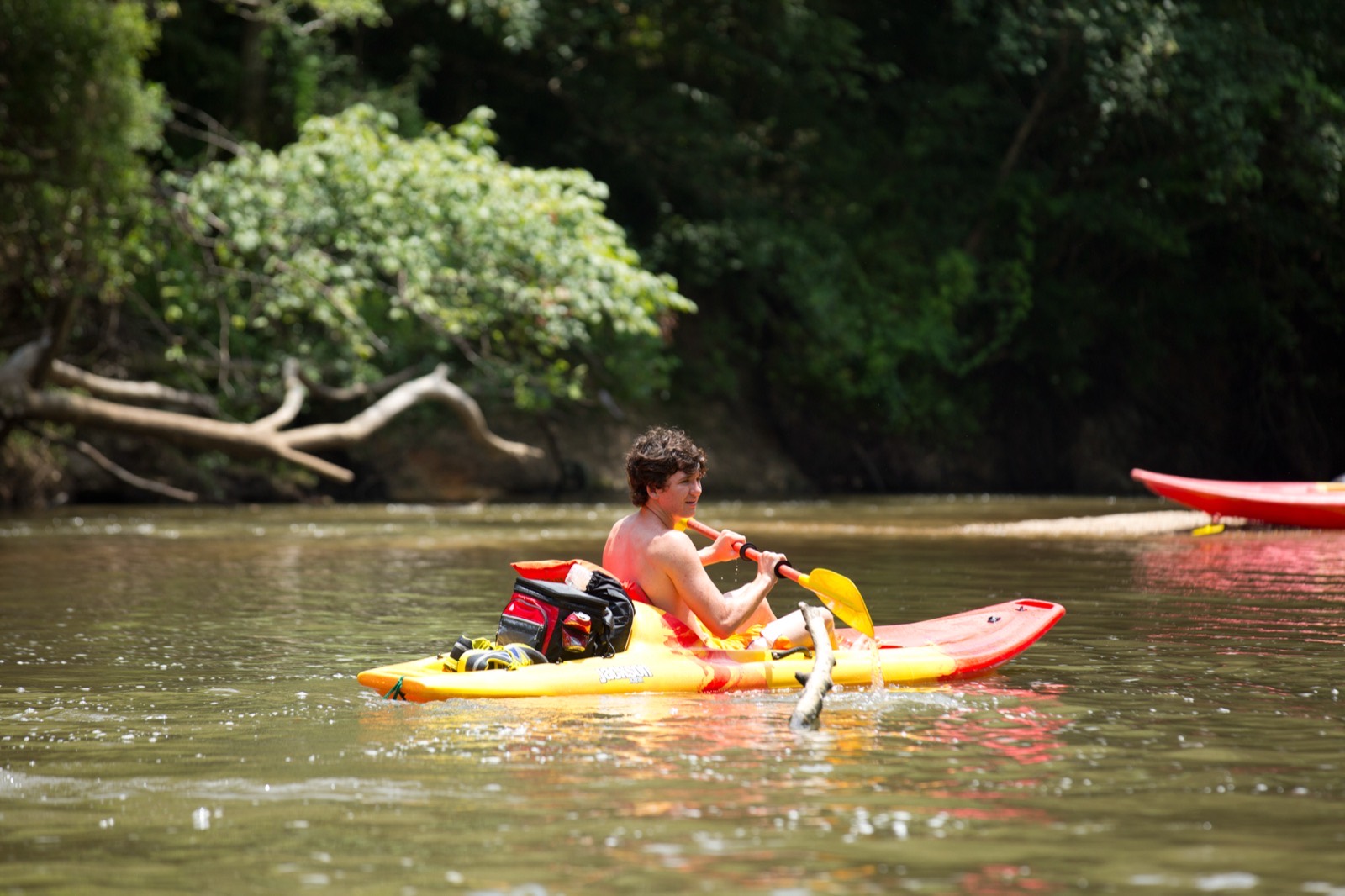
The Upper Run of Okatoma begins at Seminary (MS HWY 590) and ends at Sanford (MS HWY 598). It is approximately 13 creek miles with 3 main waterfalls. The trip usually takes 4 to 6 hours; this allows ample time for picnicing and swimming.
Again, their words. Same put-in as the short trip, roughly six more creek miles on the end of it, and a different take-out.
Thirteen miles is a whole day, and you should treat it like one. Start early. Four hours is what a group that keeps moving does; six is what a group that swims at every fall does, and six is the honest number to plan around — because the Post closes at 6 PM and nobody enjoys the last two miles in a hurry. Pack more to drink than you think you need. South Mississippi in August takes water out of you faster than the paddling does.
What you get for the extra miles is quiet. The long middle of this run is where the creek stops being a place you are visiting and starts being a place you are in — long green bends, bluffs on the outside, sand on the inside, and no bridge or road noise for a good while. People who have done the short trip twice come back and do this one to get that part.
A few honest notes. A double kayak or a canoe covers thirteen miles more comfortably than a single, because two people can trade off. If the creek is low, thirteen miles takes longer than it does when the creek is up — see what the water level means. And if you have never been in a boat before, do the seven-mile run first. It is not a test you need to pass.
Which run is yours?
Nobody at the counter minds being asked. But if you would rather decide in the truck, this is roughly how it sorts out.
First time in a boat
Take the 7-mile Upper Short. It has the three falls, it has the swimming, and it gives you back your afternoon. If you hate it — and almost nobody does — you have only spent half a day finding out.
You want the whole day
Take The Upper Run, 13 creek miles. Put in early, plan for six hours, and carry enough water for a hot afternoon. This is the one for people who have already done the short trip and want more creek.
Small kids in the party
The 7-mile run again, and go on a weekday if you can. Mississippi law requires anyone 12 years and under to wear a life vest at all times, and state law requires one life vest per person in every boat regardless of age.
Canoe or kayak?
This is the question the counter gets most, and there is no wrong answer — the same creek is under both boats. Here is how the two actually differ.
The canoe
A canoe is the sociable boat. Two people, one hull, facing the same way, and a floor between you for the cooler and the dry bag. It carries more than a kayak and it carries it drier. Two life vests are provided with the rental of each canoe.
The trade is that a canoe has to be paddled as a team. The person in the stern steers; the person in the bow provides power and calls the line through a shoal. If both of you paddle on the same side with the same enthusiasm, the boat spins, and you will both find this hilarious exactly once. Ten minutes of flat water at the start sorts it out.
A canoe also sits higher, which means wind pushes it around more and a sideways shoal grabs it harder. Square to the drop, every time.
The kayak
Our single kayaks are one person, sit-on-top boats good for any age from 8 to 100. You are provided with one double blade paddle and life vest. Kayaks are very safe and stable in the water.
Sit-on-top is the important part. You are not sealed into anything. If you come off, you come off into the creek and climb back on from the side — no skirt, no roll, no drama. That is why a nervous first-timer is often better off in a kayak than in a canoe: nothing about it can trap you, and you are not depending on a partner to get the line right.
The double kayak splits the difference — two paddlers, two double blades, more control than a canoe and more capacity than a single.
The short version
Cooler, camera bag, a partner you like paddling with — canoe. Want to be in charge of your own boat, or slightly nervous about the whole idea — single kayak. Two of you and thirteen miles ahead — double kayak.
Whichever you pick, wear old tennis shoes. The ledges are rock and they are slick. There is a full list on what to bring.
The falls, and what people do at them
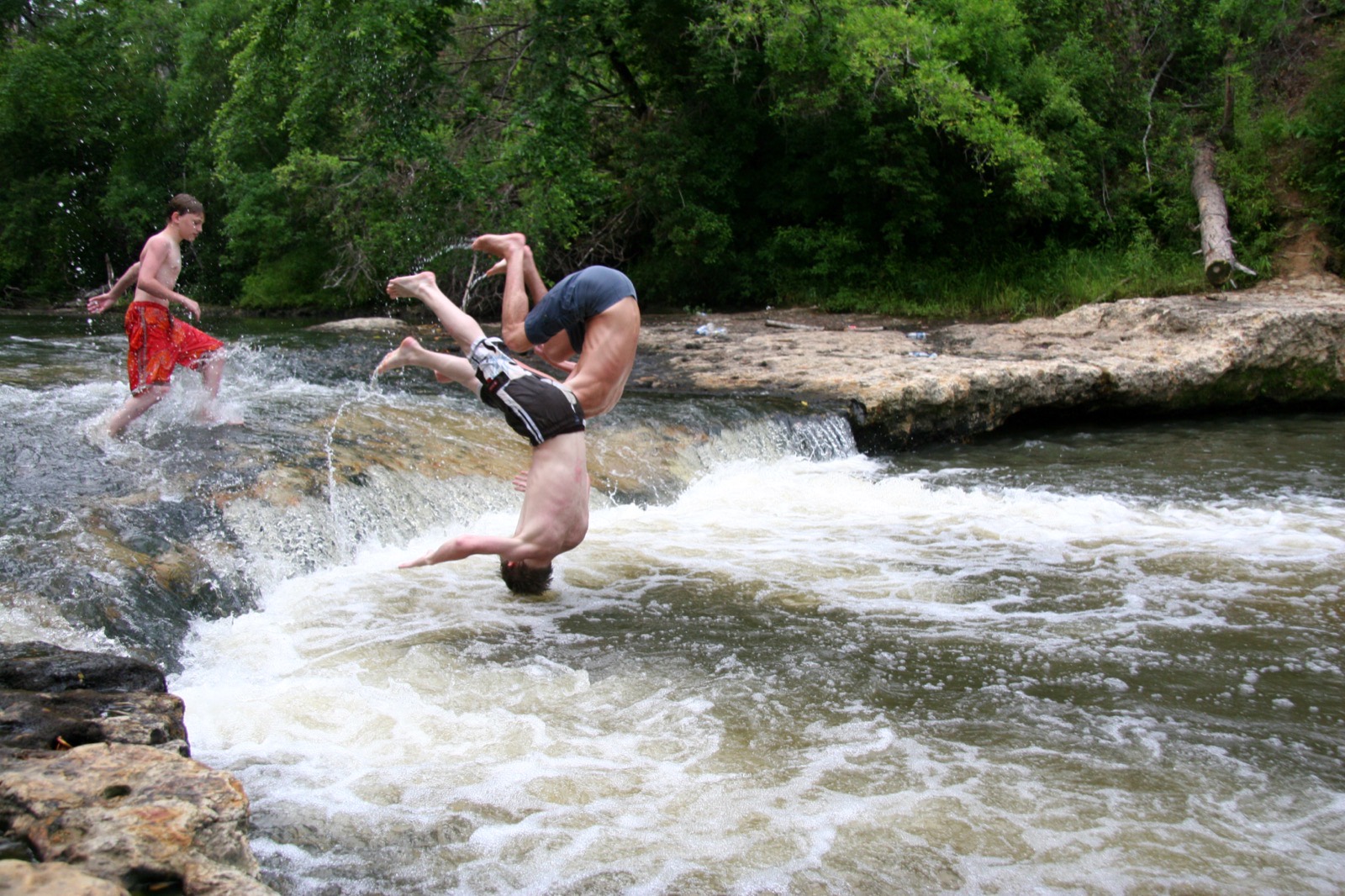
Three main falls on the upper run, and every one of them has a pool underneath and a rock shelf beside it. This is where the trip slows down.
A word about that, because it is the one place a good day goes wrong. The ledges are sandstone, they are wet, and they grow algae. People walk them barefoot and people slip. Old tennis shoes on the water, on the rock, and in the boat — not flip-flops, which the current takes off your feet and keeps.
What is under the water changes with the season and with every big rain. A pool that was chest deep in April can be knee deep in August, and the gravel moves. Look before you jump, every single time, on every single trip, no matter how many times you have run this creek. That is not a house rule, it is just how a sand-and-gravel creek works.
And our river policy, in our own words: "Above all we want your adventure to be a safe and happy one. Therefore we ask that all our guests use common sense and good manners while on the river. Much of the property along the river is privately owned. Please respect the property rights and wishes of the landowners. Do not throw trash or cans into the river, or leave anything on the gravel bars. Place all litter in a litter bag and keep in canoe until the end of the trip."
What a float costs
Both trips are the same price — you are renting the boat for the day, not the mileage. These are the rates as they appear on our Information & Pricing page.
| One-Day Rental | Overnight Rental | |
|---|---|---|
| Canoe | $50 | $75 |
| Single Kayaks | $40 | $65 |
| Double Kayaks | $65 | $80.00 |
Private Canoe Haul: flat rate $25.00
FOR NON-RENTING OKATOMA CREEK CANOEIST — Check-in office for pricing and fees.
There is also a Special Weekday Rate for 6 or more boats. It is set out with the deposit rule on the groups page.
PRICES SUBJECT TO CHANGE WITHOUT NOTICE
PRICES DO NOT INCLUDE TAXES OR FEES
Reservations should be made ahead of time, especially for weekend floats. RESERVATIONS REQUIRED-CREDIT CARD REQUIRED TO HOLD RESERVATIONS-
PHONE FOR RESERVATIONS
601-722-4297 or 1-888-OKATOMA
Questions about the two runs
How long is the float on the Okatoma?
There are two. Upper Short to Fairchild is approximately 7 creek miles and usually takes 3 to 4 hours. The Upper Run is approximately 13 creek miles and usually takes 4 to 6 hours. Both begin at Seminary (MS HWY 590). The short one ends at Fairchild's Landing; the long one ends at Sanford (MS HWY 598).
Do both trips have the falls?
Yes. The 7-mile Upper Short to Fairchild carries the 3 main falls of the upper run, and The Upper Run has 3 main waterfalls. If you came for the falls, either trip gets you to them.
Where does the trip end — do I have to wait for a ride back?
No. We provide complimentary transportation up river for a leisurely float back to your vehicle. You leave your car at the Post, we haul you and your boat upstream, and you paddle back down toward it. The shuttle happens at the start of your day, not the end of it.
Is the Okatoma safe for beginners?
We offer our rentals on the Okatoma Creek, a Class A River — long easy stretches with ledge drops between them, not a whitewater run. Most first-timers take the 7-mile trip and do fine. Mississippi law requires anyone 12 years and under to wear a life vest at all times. State law also requires one life vest per person in each boat. We suggest that everyone wears their life vest. Single Kayaks are one person, sit on top boats good for any age from 8 to 100. If you are bringing small children in a canoe, call the office on 601-722-4297 and ask before you book.
Can I do the long run and still get back before you close?
The Upper Run usually takes 4 to 6 hours and we are open 8 AM – 6 PM. Plan around the six, not the four, and put in early. If you are not sure what time to arrive for the day you want, call 601-722-4297 — that is a question the office answers all day long.
What if the creek is high or low?
Creek level changes what a float feels like — a low creek is slower and shallower, a high creek is faster and pushier. There is a plain explanation of what the gauge readings mean, and a link to the USGS gauge, on our water level page. If the creek is up, or it has rained hard upstream overnight, call 601-722-4297 before you drive out.
Both runs, one phone number
Reserve ahead, especially for a weekend.
Six or more canoes require a deposit 2 weeks in advance. RESERVATIONS REQUIRED-CREDIT CARD REQUIRED TO HOLD RESERVATIONS-
Open 8 AM – 6 PM, March 1 – October 31.